SUMMARY
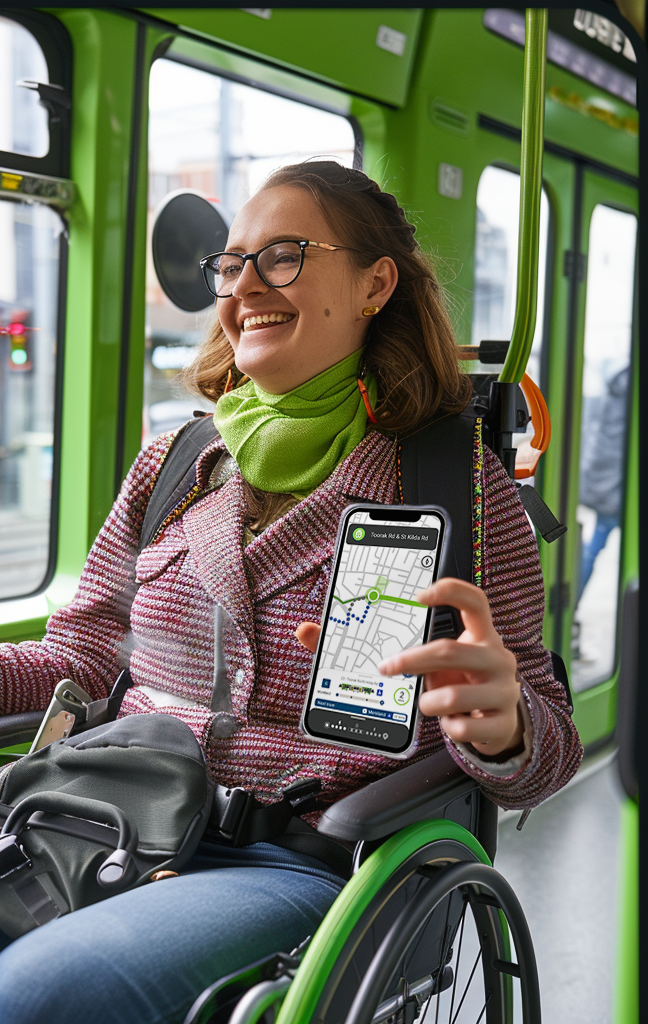
Our target audience are wheelchair- or scooter-users living along Melbourne’s tram lines, particularly those serviced by accessible trams. Currently, when these users activate accessibility mode on the PTV app, they are directed to take trains or buses, as trams are not included as an option. This poses concerns for users, fearing they may not be able to board or disembark from trams at their intended stops or that they may encounter inaccessible paths around stations. Without the accessibility mode, the path to find accessible trams or stops is non-intuitive and tedious. This design flaw can be explained by the shortage of accessible tram stops in Melbourne, since the development of these has stagnated, in combination with the low amount of accessible trams. This project set out to build a tool which works around this lack of infrastructure, by providing concepts for an updated accessibility function in the PTV app, named the PTV Assist.
PROBLEM
For wheelchair users to utilise Melbourne's trams, these things need to be in order:
1. The tram needs to be a low-floor tram (older trams feature steps to enter/disembark)
2. The tram stops (both departure and arrival) need to be Superstops with a raised platform
Analysis of the tram network displays how most tram lines don't meet the criteria for universal design.
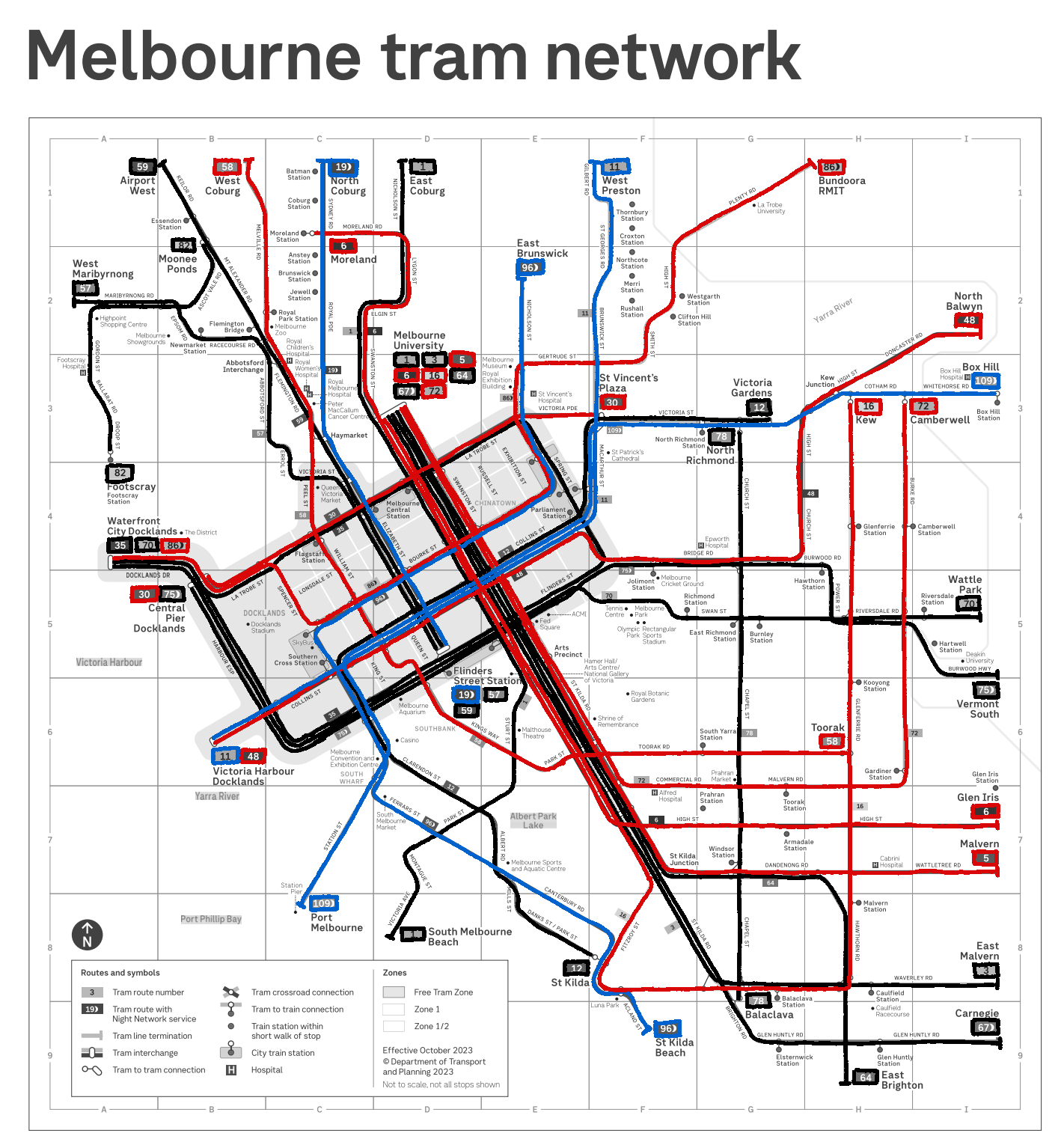
Lines serviced by low-floor trams make up 12 out of 24 tram lines, where only 4 lines only use accessible trams. In the image, the black tramlines feature no accessible trams, the red tramlines are partially covered with accessible trams, while the blue tramlines are fully accessible.
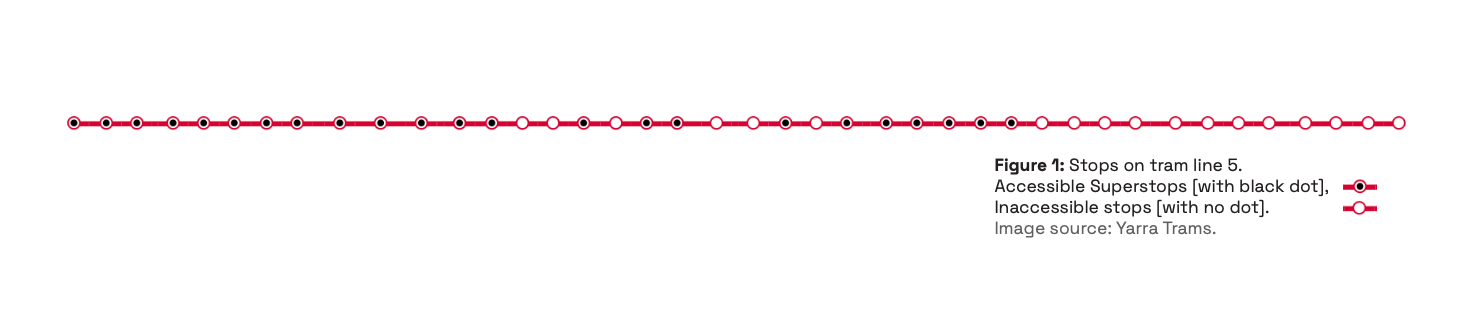
To make matters worse, most stops on these lines aren't accessible stops - meaning that users will be stuck on the tram until they reach a "Superstop" where they can exit.
Only a part of Melbourne's tram stops are superstops, which are stops with an accessible raised platform. Unfortunately, the development of these has stagnated. “Not a single stop on Melbourne’s tram network has been made more accessible in the past 12 months and only four were delivered over the past three years” (Hatch, 2023).
SOLUTION
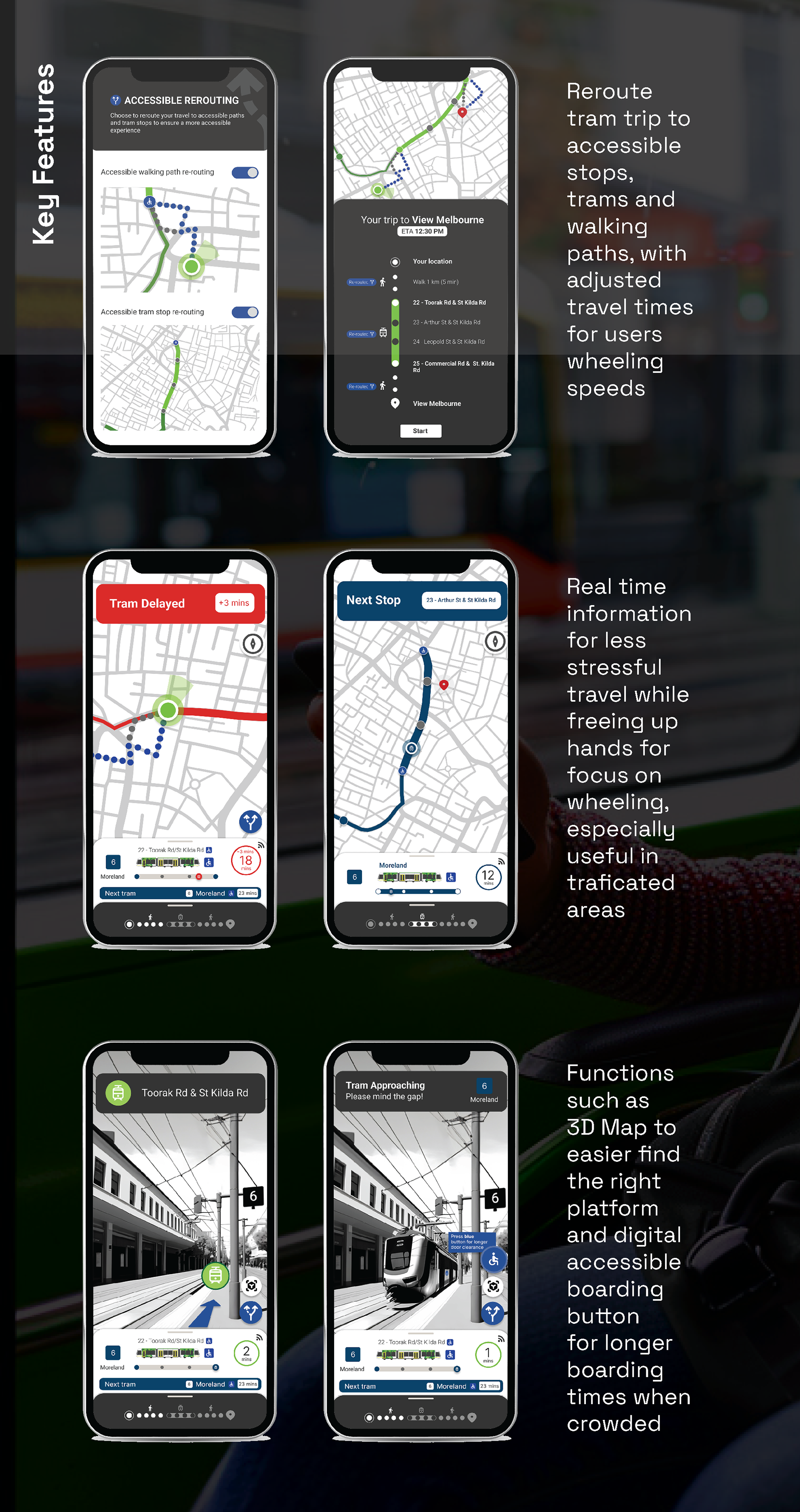
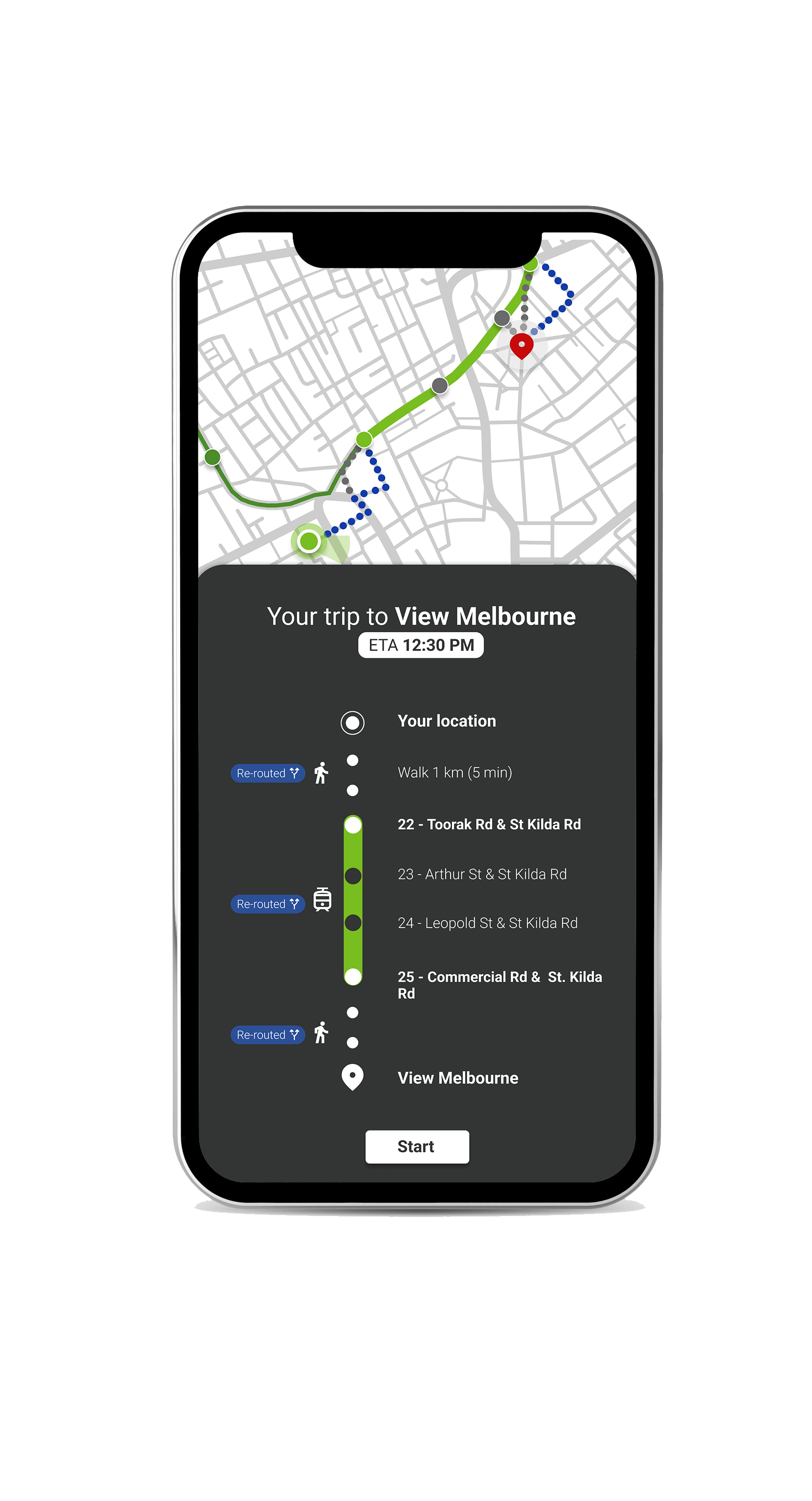
To address these issues, the project aimed to redesign the app to instil confidence in users regarding their ability to board and disembark at planned tram stops and get to their end destination. We do this by ensuring clear information about accessibility and providing rerouting options. This project also seeked to assist users while freeing up their hands for wheeling, making travels safer and minimising planning time. For every step of the way the app will change focus to reduce the amounts of clicks needed. This will be achieved through wheelchair friendly routes, real time information updates and the digitalisation of the blue accessibility boarding button. The project aimed to make the user interface intuitive and give the user control over the functions.
PROCESS
A service design approach was used to understand the accessibility challenges in the tram network in Melbourne. This involved mapping out the full journey of wheelchair users and identify critical pain points within the service, before designing solutions.
1. Mapping the Service Journey
The project started with research, interviews and observations related to the service, to map the entre tram travel experience for wheelchair users, from planning in the app to arrival at destination.
2. Identifying the Pain Points
The journey mapping revealed how accessibility challenges occur across multiple stages of the service, such as travel app shortcomings, fear of disembarking and longer travel times due to inaccessible trams and stops. These design opportunities lead the project to achieve the greatest accessiblity impact.
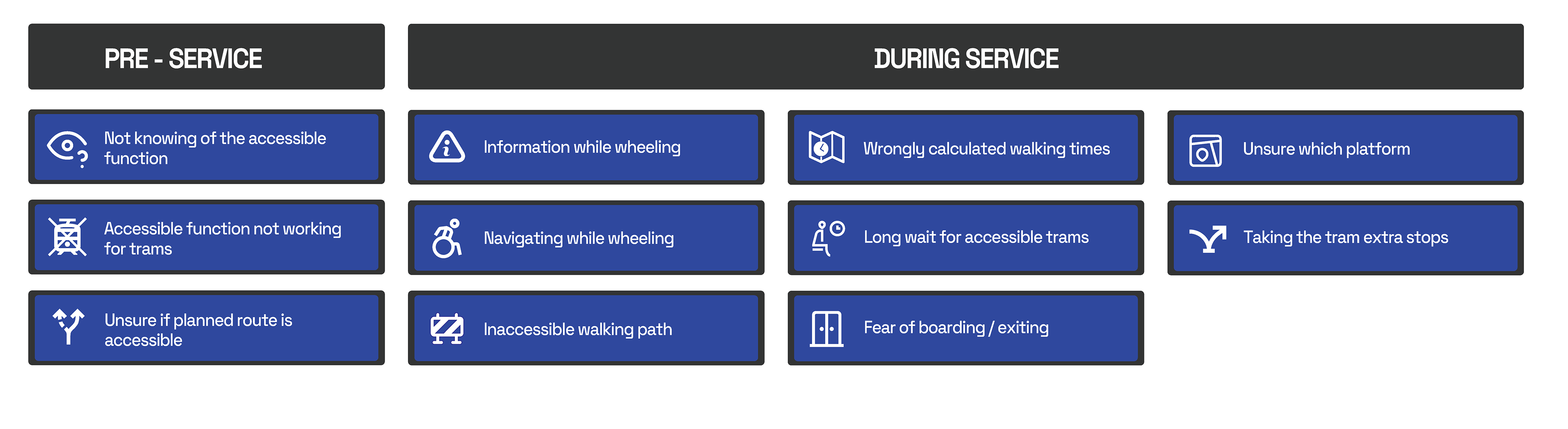
Overview of the pain points for wheelchair users in the context of public transport in Victoria.
3. Stakeholder Mapping
A stakeholder map of associated organisations and actors was developed to clarify who had authority to make changes in the tram service and who would have interests in the benefits. This revealed that primary stakeholders who are directly affected by the changes, have less power than secondary stakeholders who are only indirectly affected. Big and expensive changes might therefore not be prioritised, which led the project towards a more digital approach.
4. Concept Development
Many of the collected pain points could be alleviated with an upgrade to the infrastructure of the tram network, however that is an expensive and unrealistic goal when looking at the current development of accessible trams and tram stops. Therefore the project focus was set to instil confidence in wheelchair users on utilising the app for their tram travels, by providing a design proposition of an upgraded PTV app with newer accessibility functions.
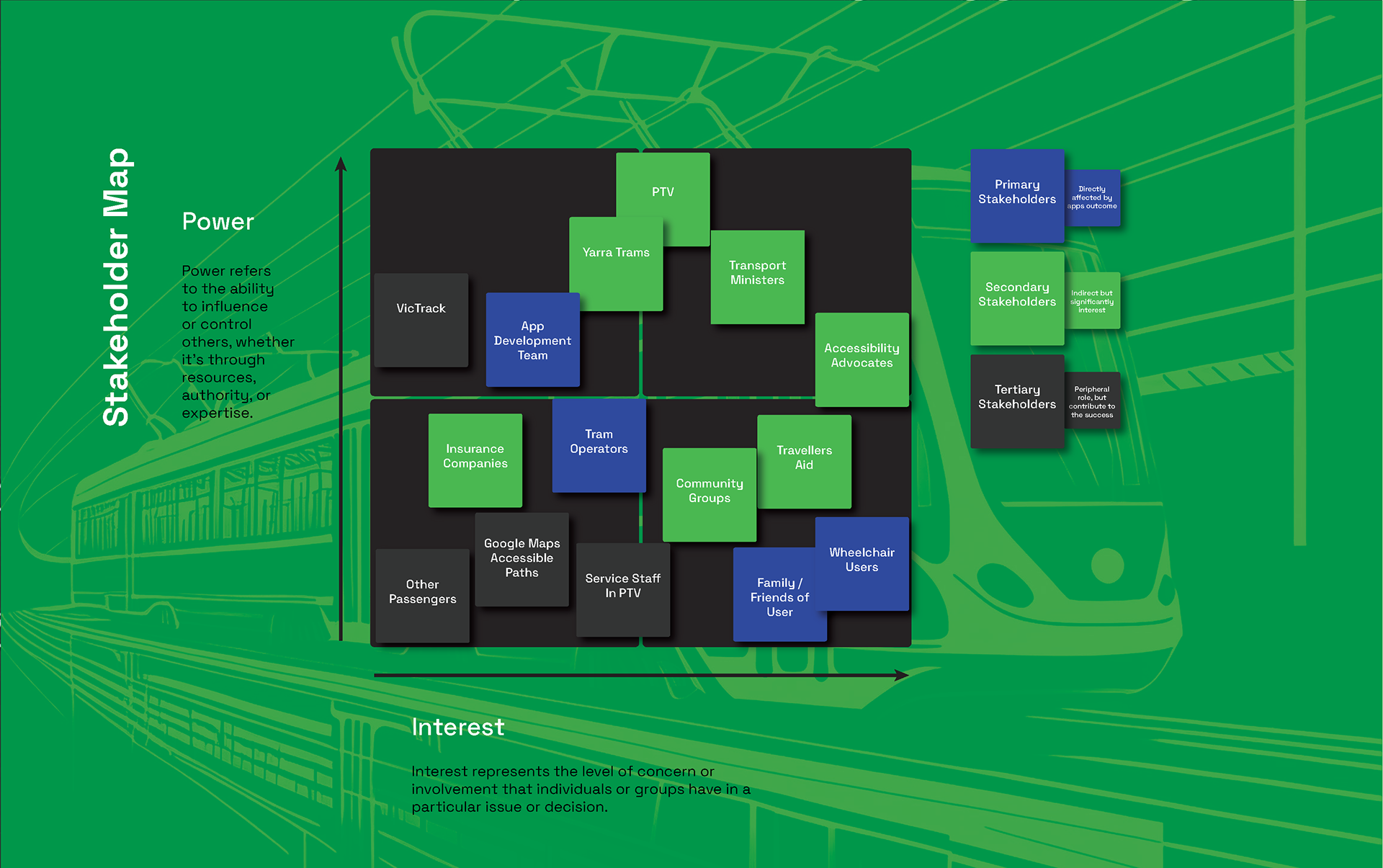
Overview of the stakeholders in the context of accessible public transport in Victoria.
5. Service Blueprint
A service blueprint was developed to visualise both the front-stage user actions and the back-stage app functions needed along the user journey. This guided the project development to incorporate new functions in conjunction with existing ones.
6. Story Mapping
Sketches illustrating the use of the future application from travel start to finish, helped the project and potential stakeholders to see the value of the upgrades. These included step-by-step scenarios such as planning an accessible route, receiving updates while travelling and clear accessible information on current route for reassurance during travel. This helped translate research insights into tangible interaction scenarios.
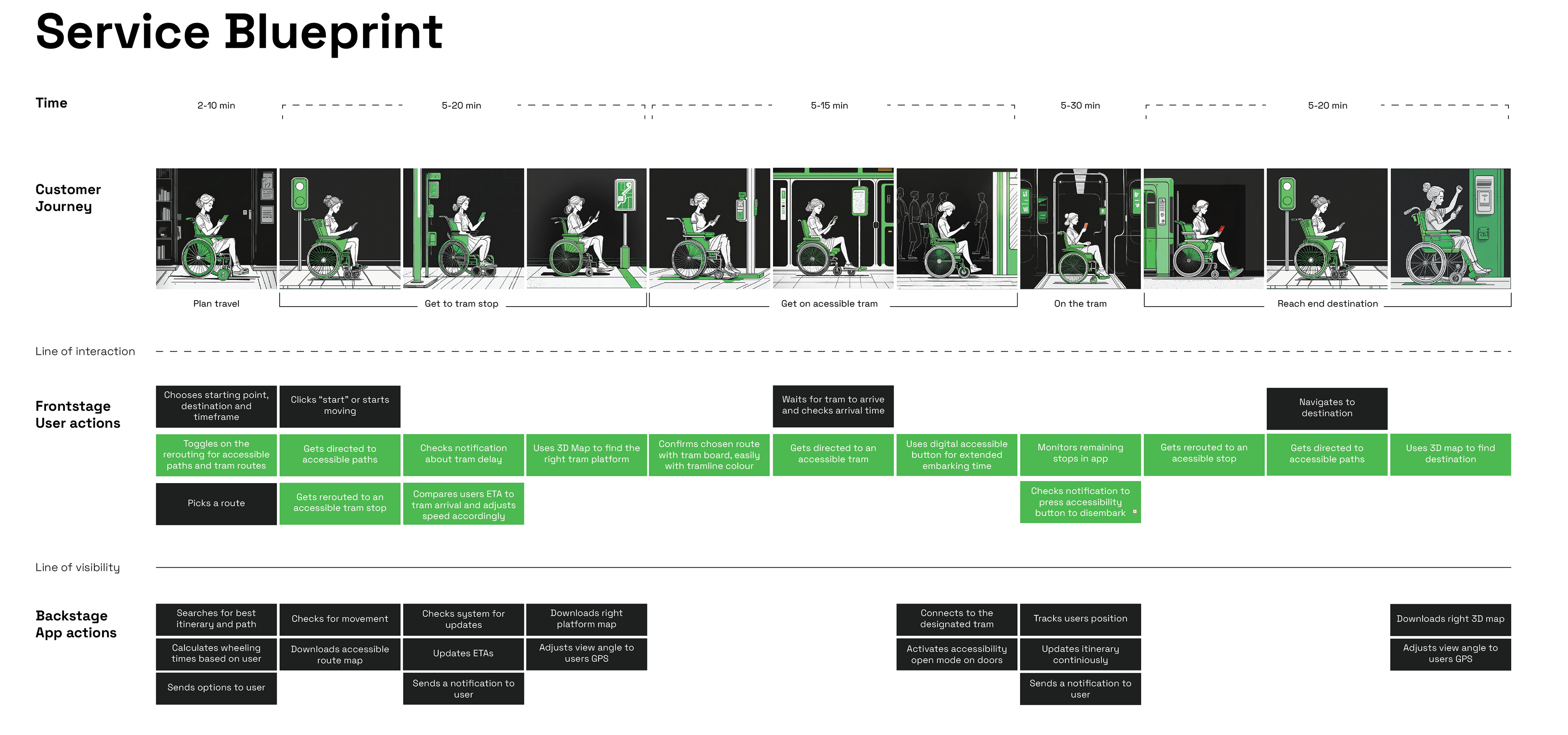
Service Blueprint on user journey, with PTV Assist's functions highlighted in green (click on image for larger)
ITERATIONS
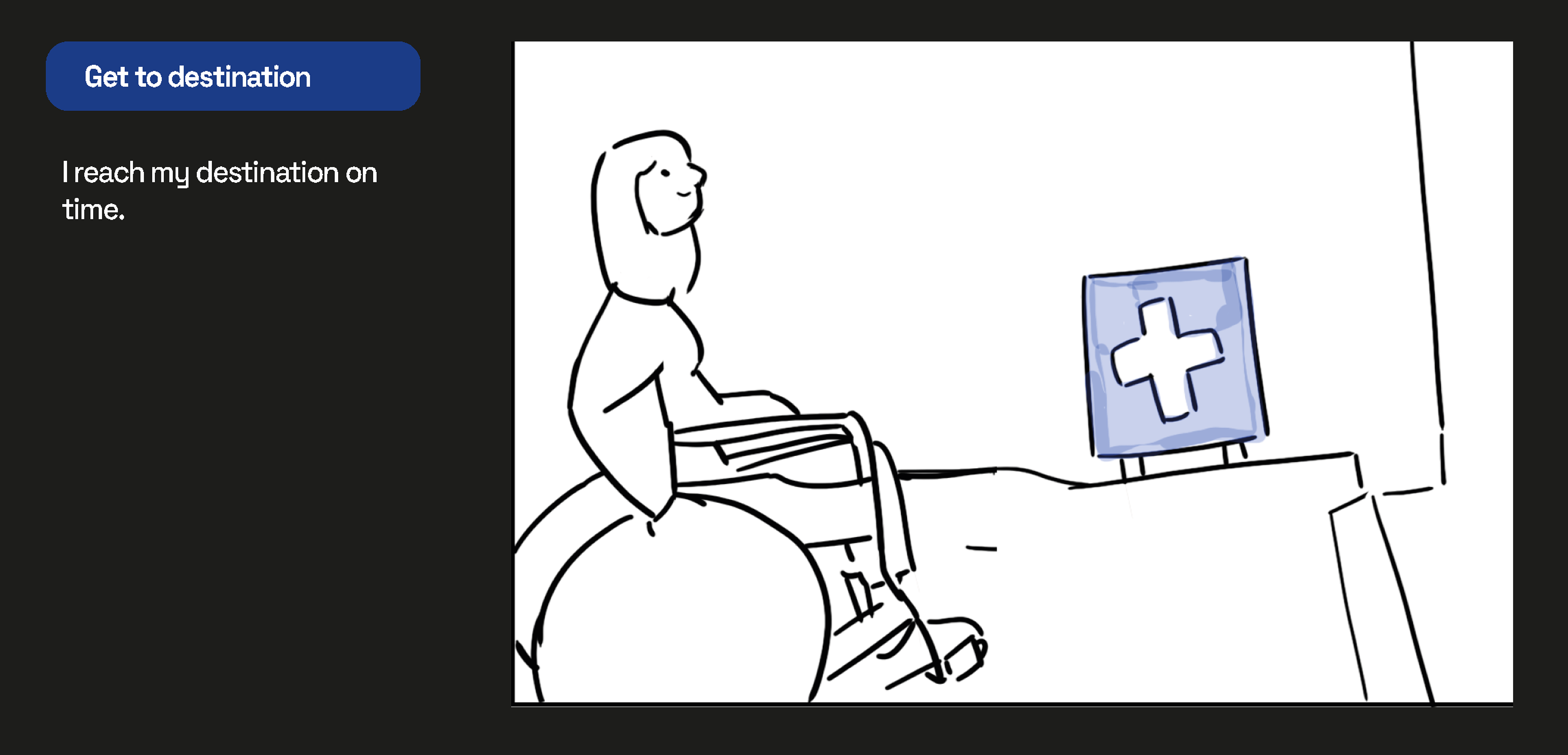
These storyboards explain selected proposed accessible functions, starting with the planning phase - fully accessible path, tram and stops confirmed to reassure user before travels.
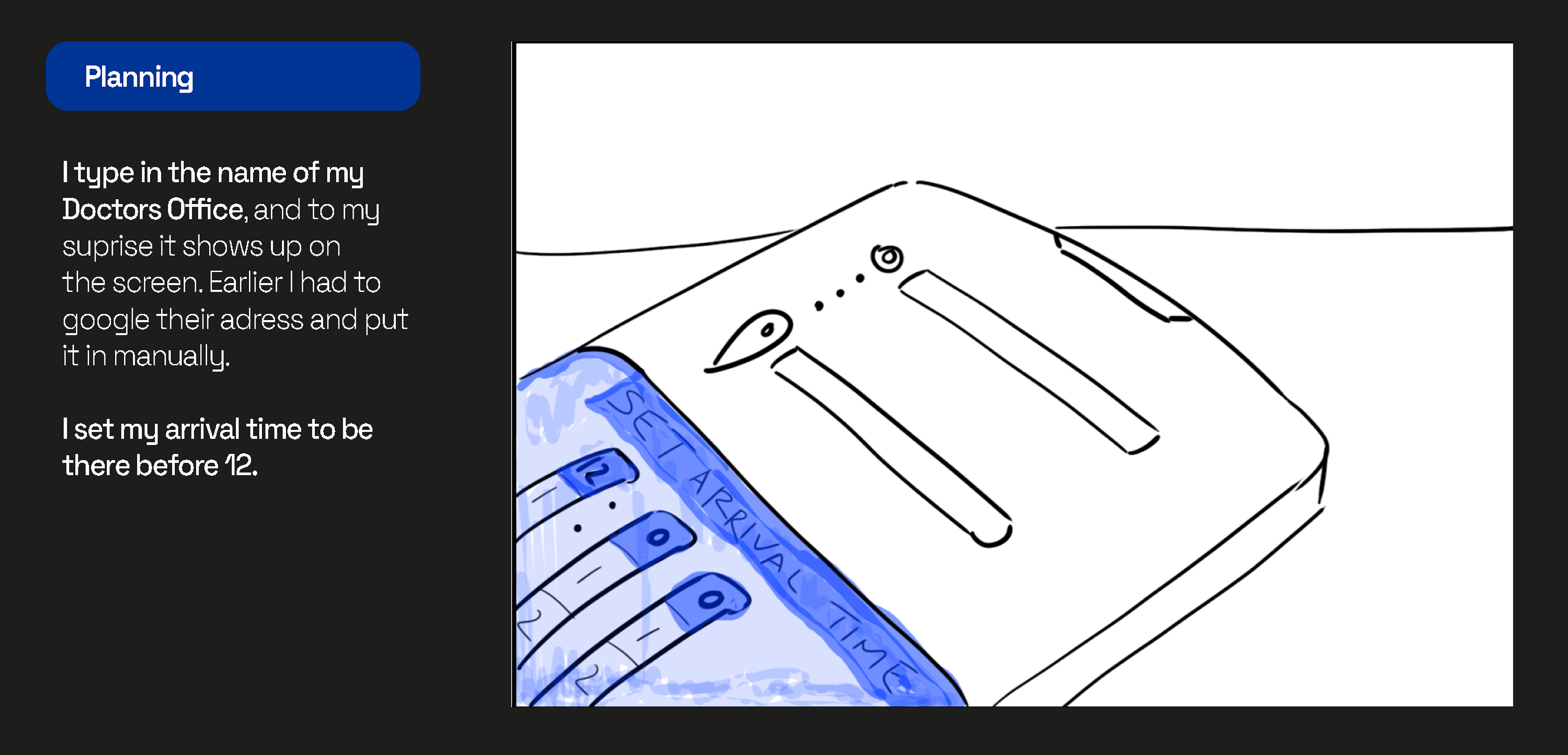
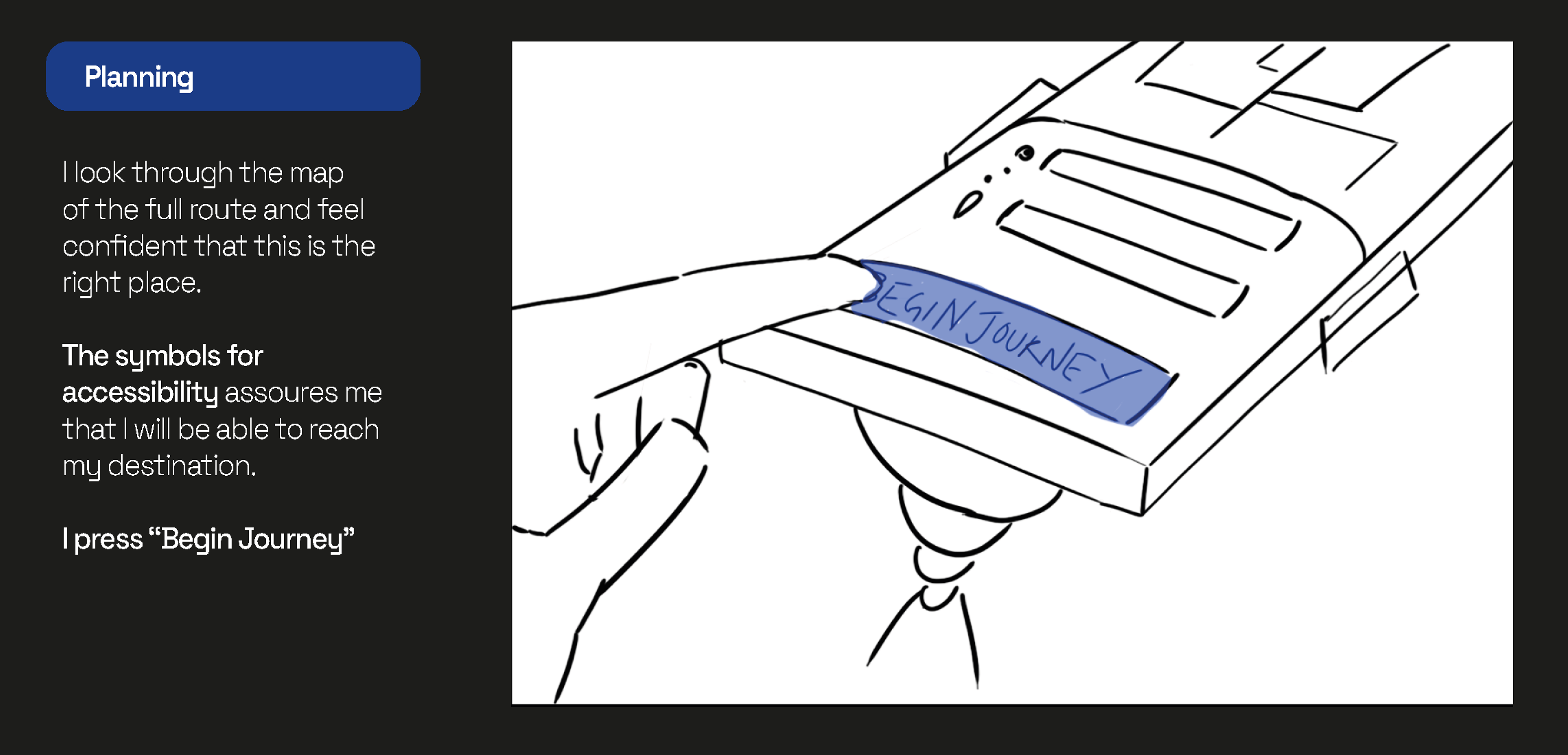
During travels the app displays all important information to avoid manual handling while wheeling, while also correctly calculating speeds for wheeling - not walking.

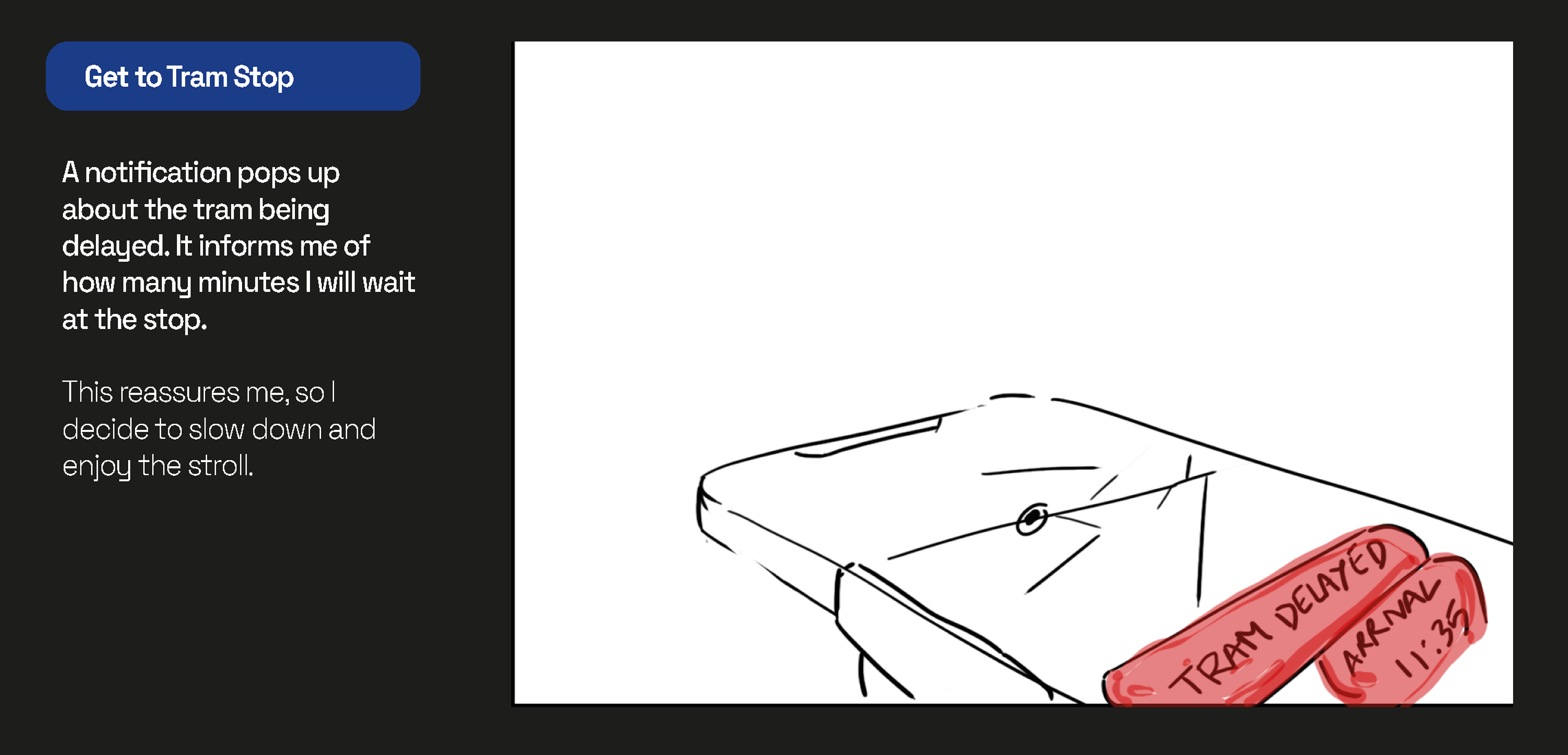
The app directs users to more accessible wheeling paths.

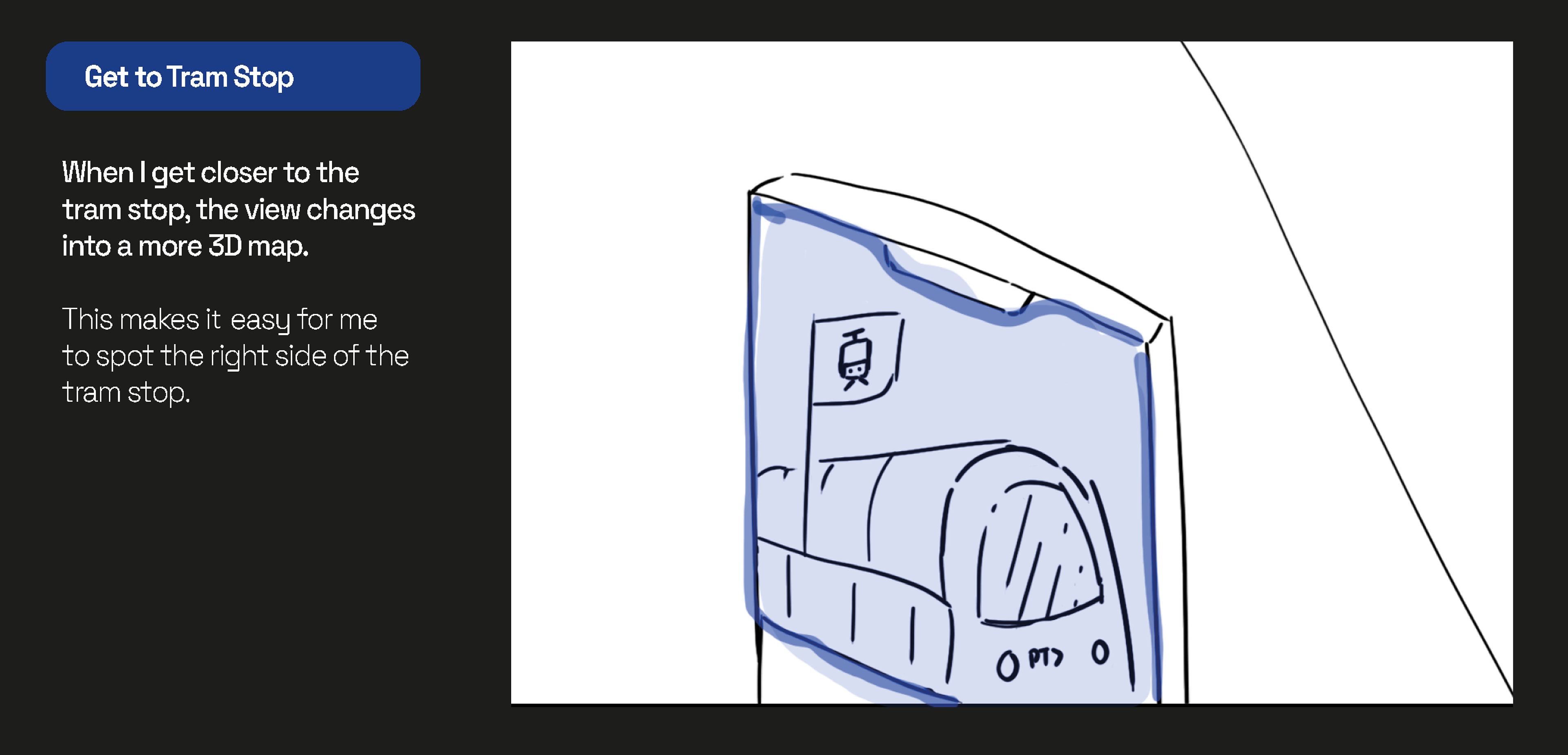
The app aids users to find the right platform by showing a 3D map. Getting to the right stop at the right time is especially important for wheelchair users, since there can be long waiting times between accessible trams.
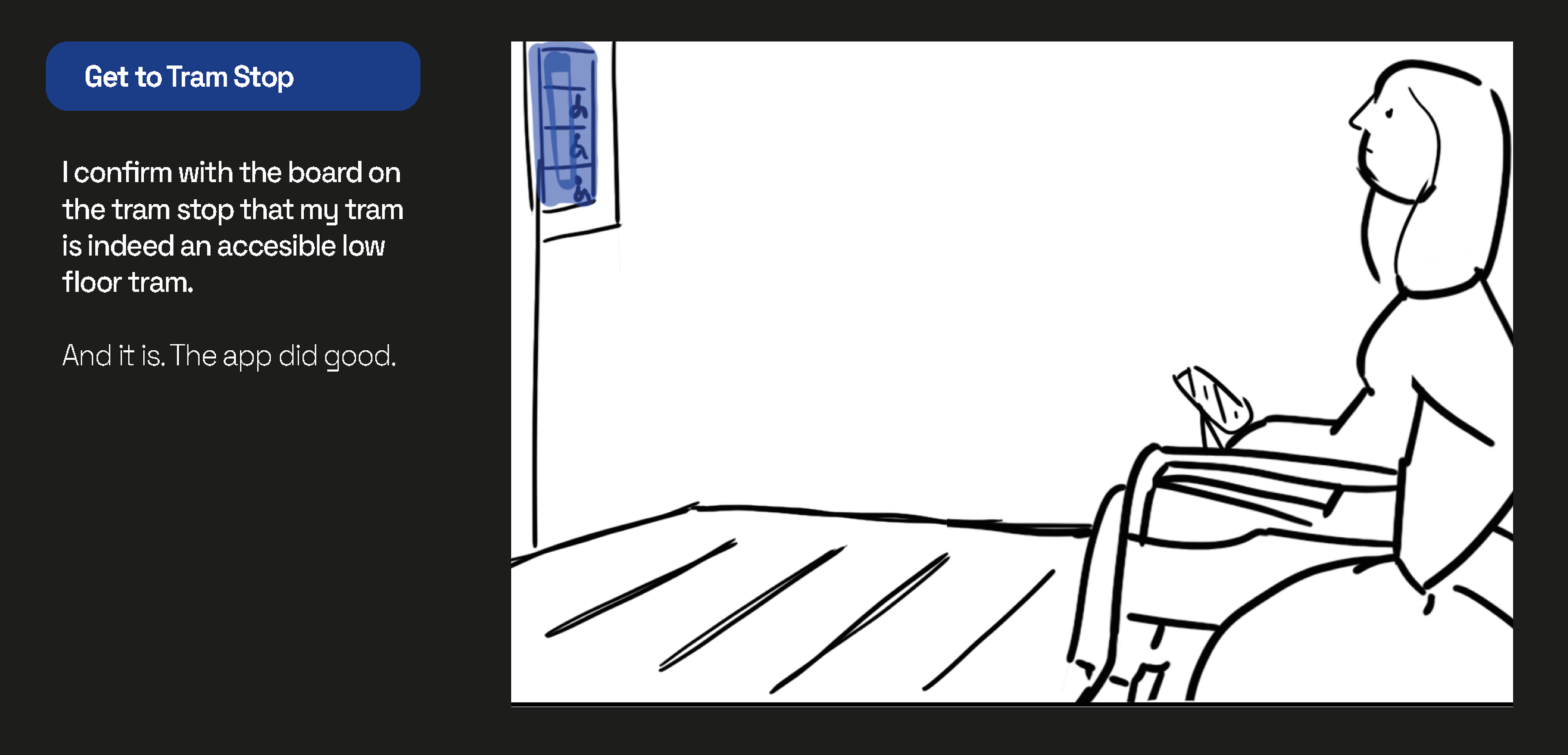
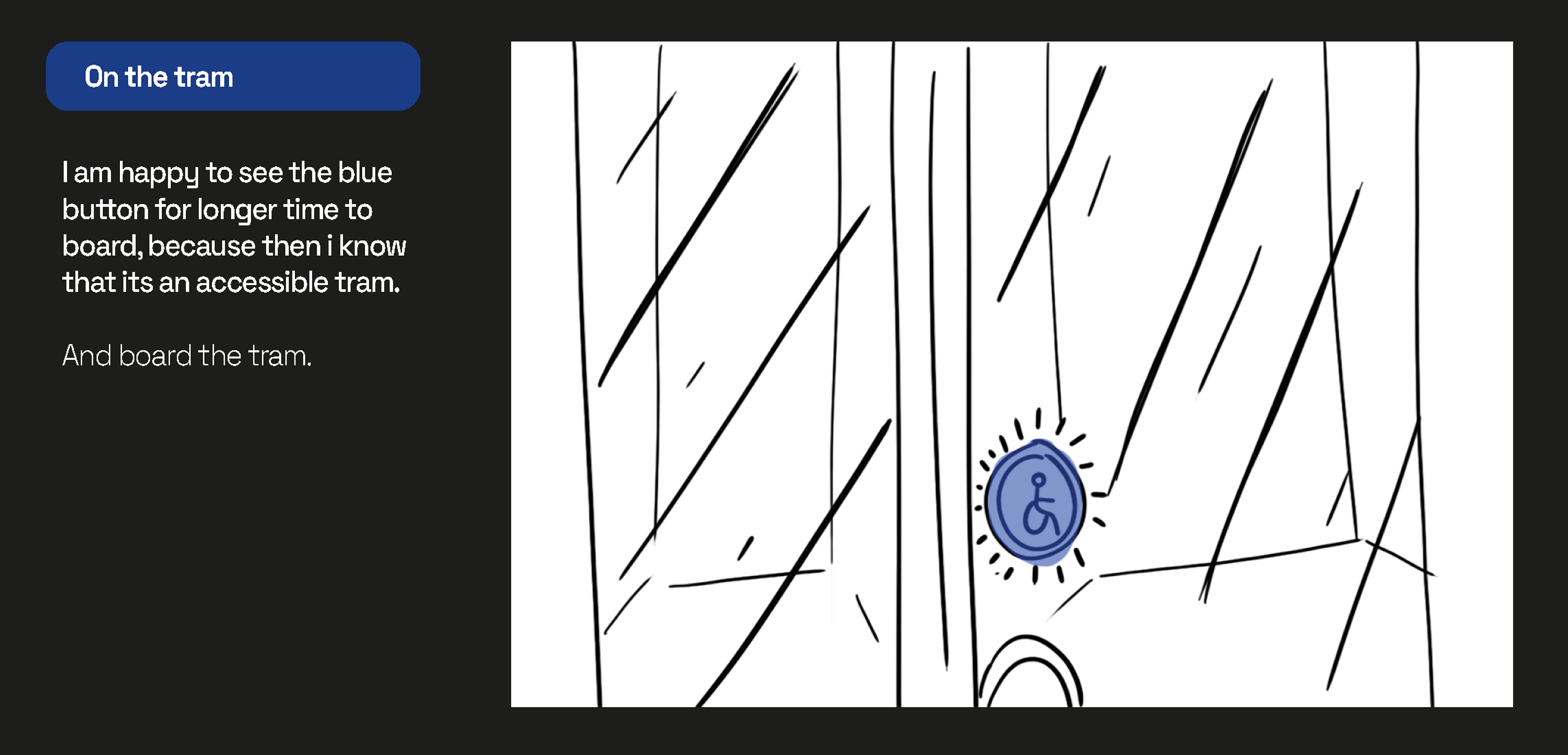
The app has a digital version of the blue accessibility button, which holds the doors open for longer than the standard button. This is practical if the platform is crowded and people board in front of the user with the standard button.
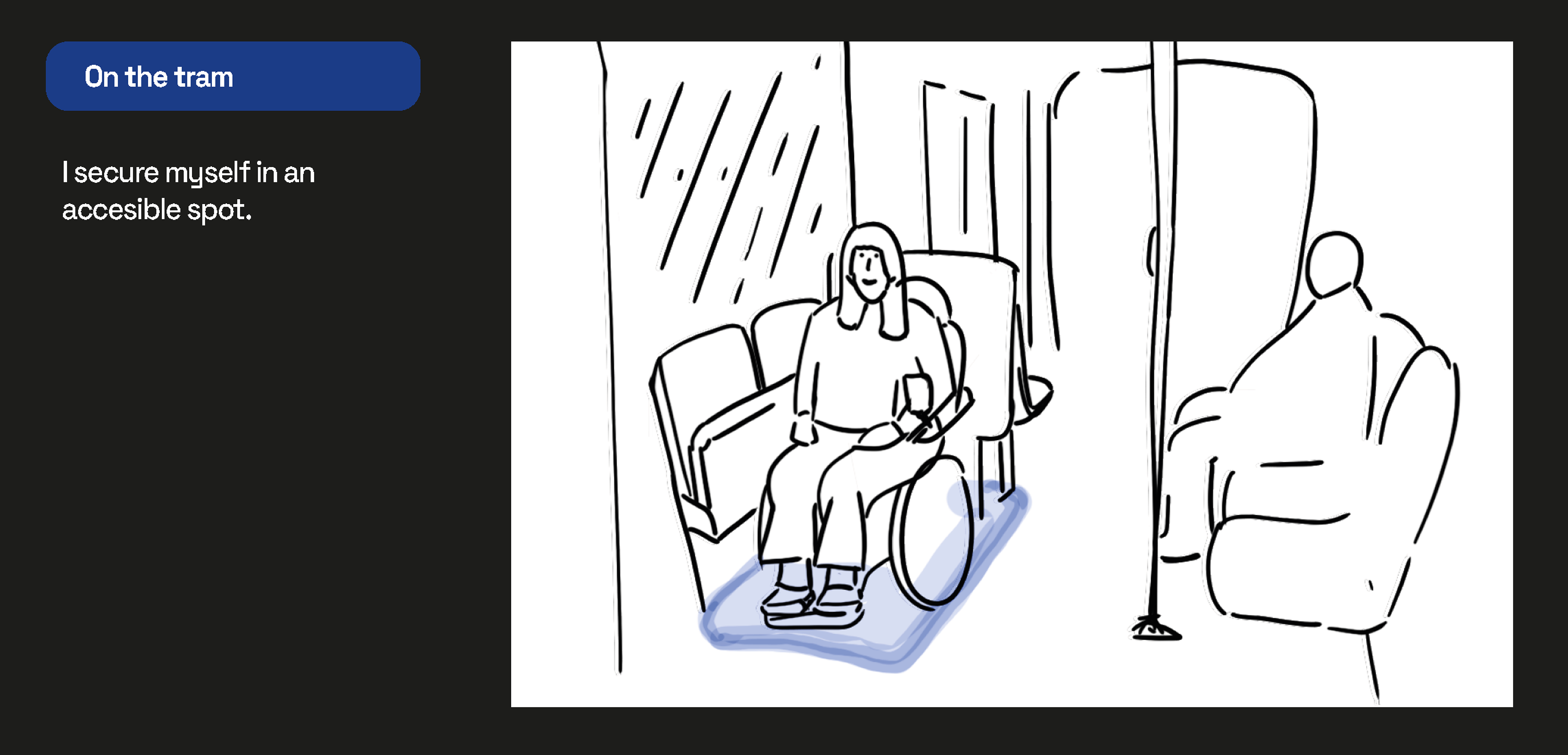
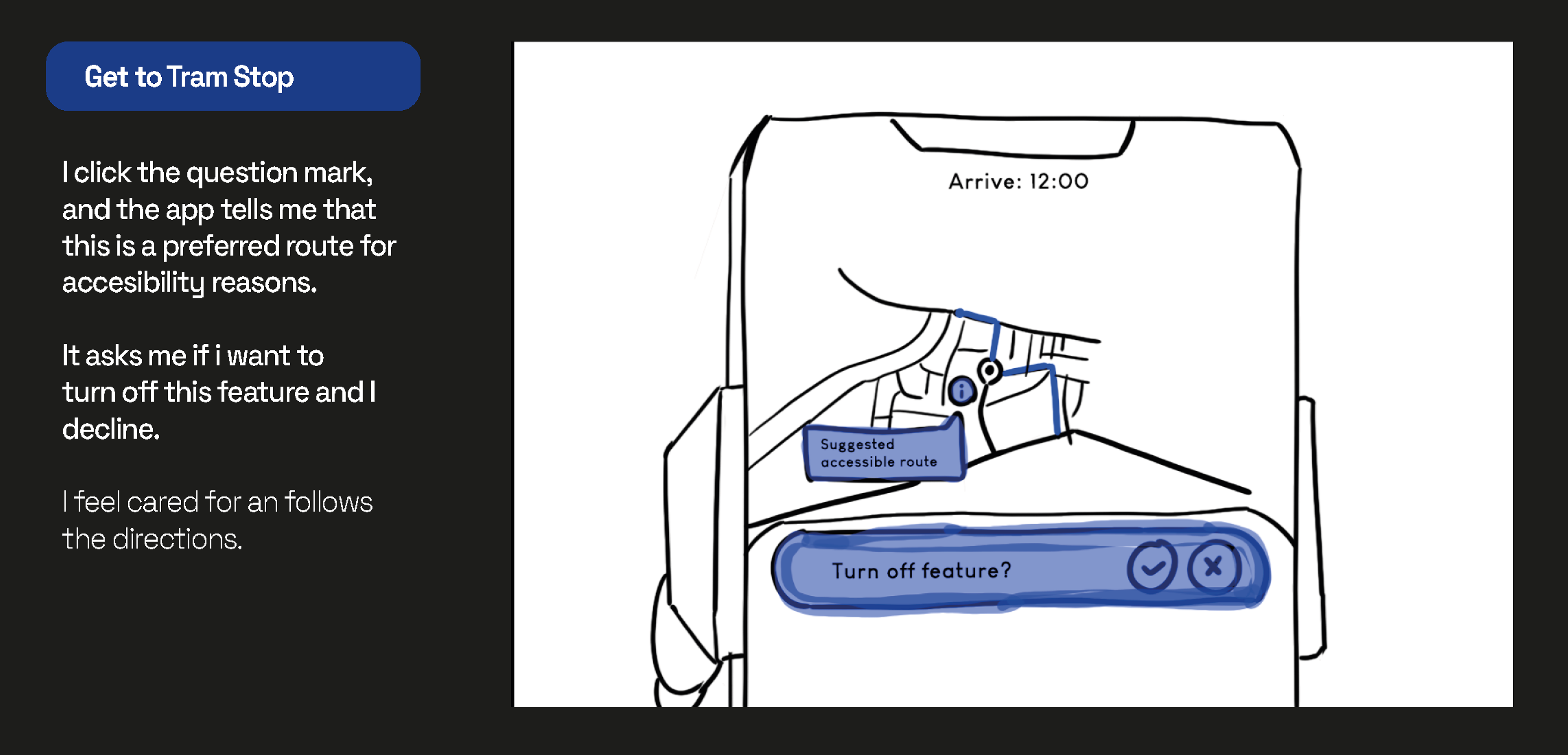
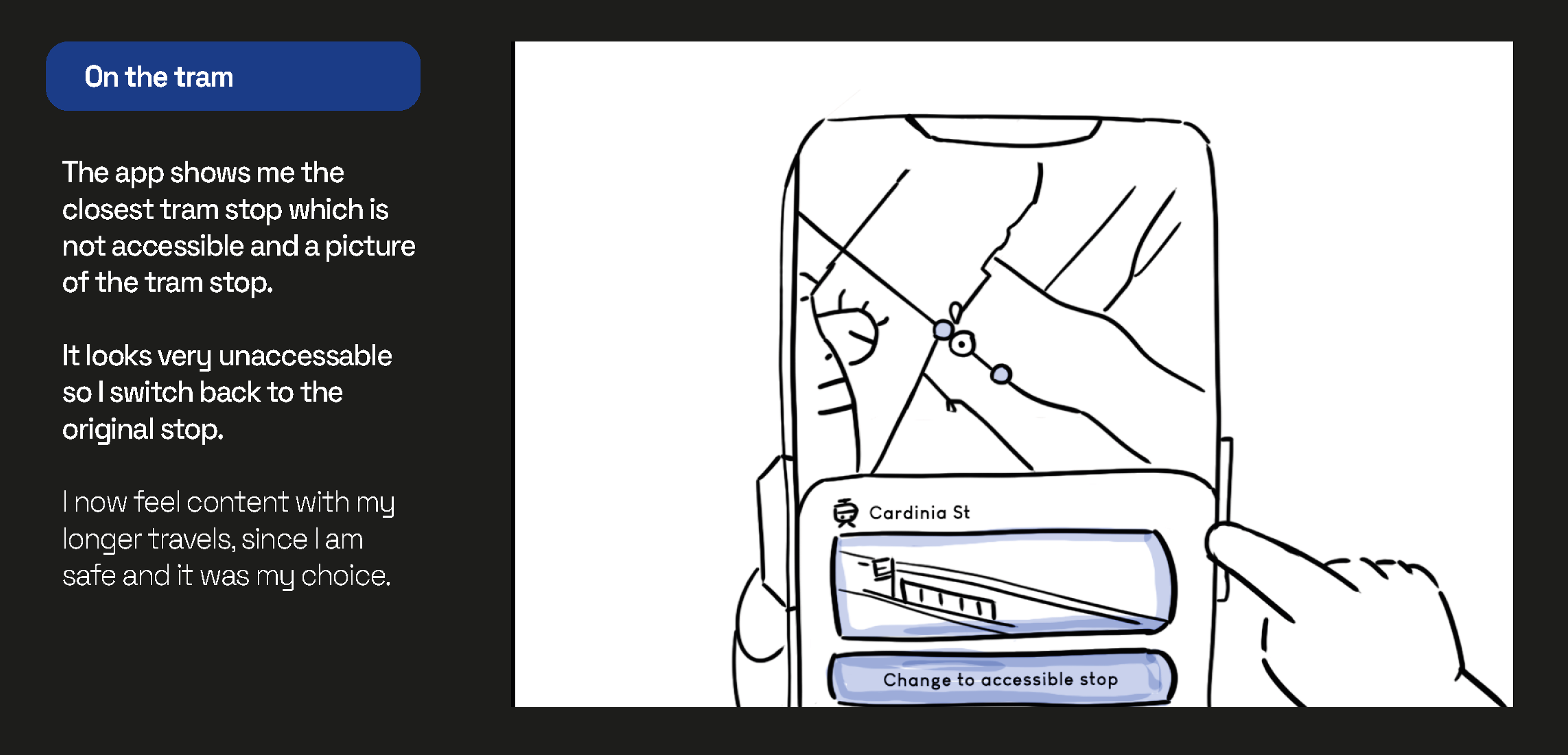
The app redirects users to accessible Superstops, for their own safety and hassle free travels. It lets users control this feature themselves, which gives a sense of ownership over the extended travel.
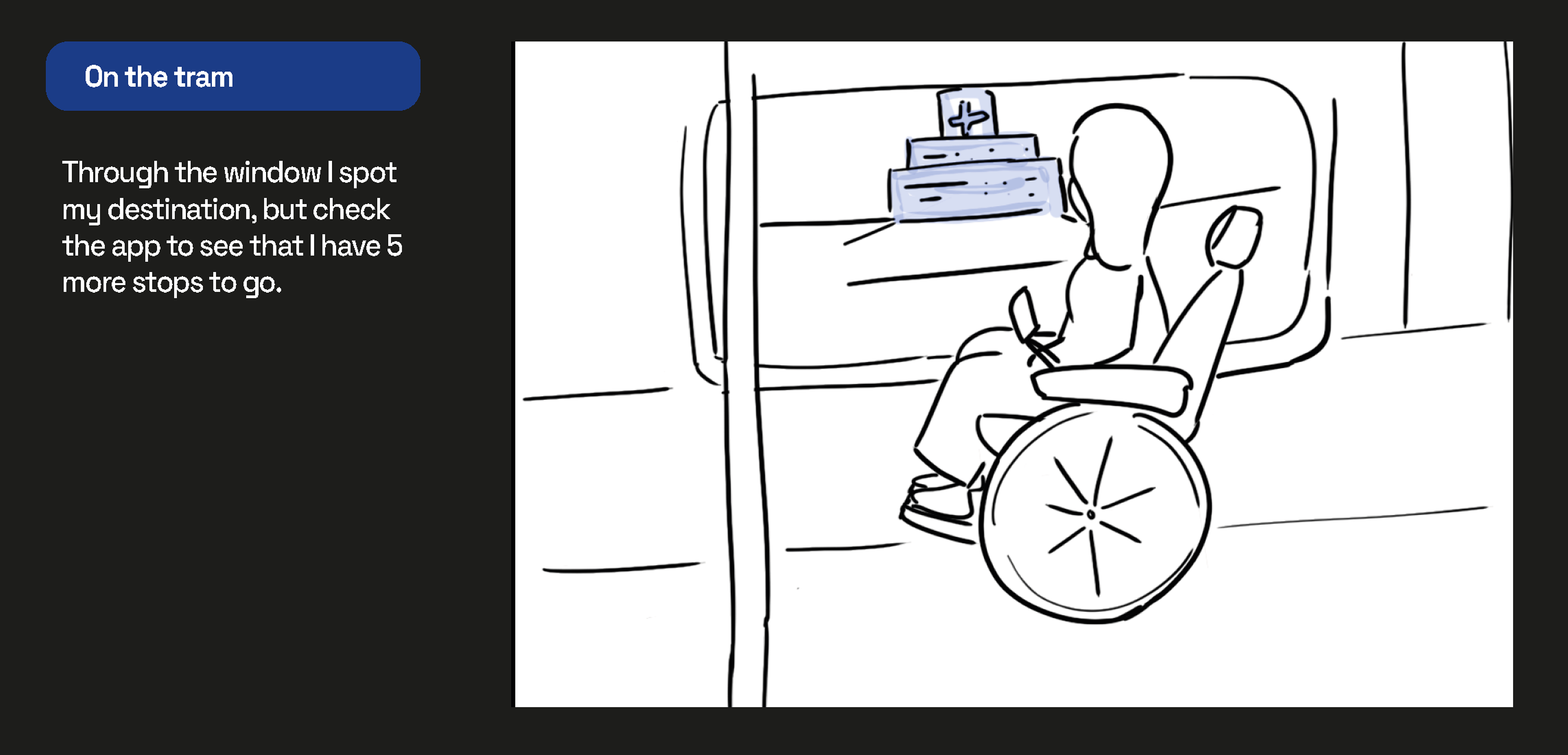

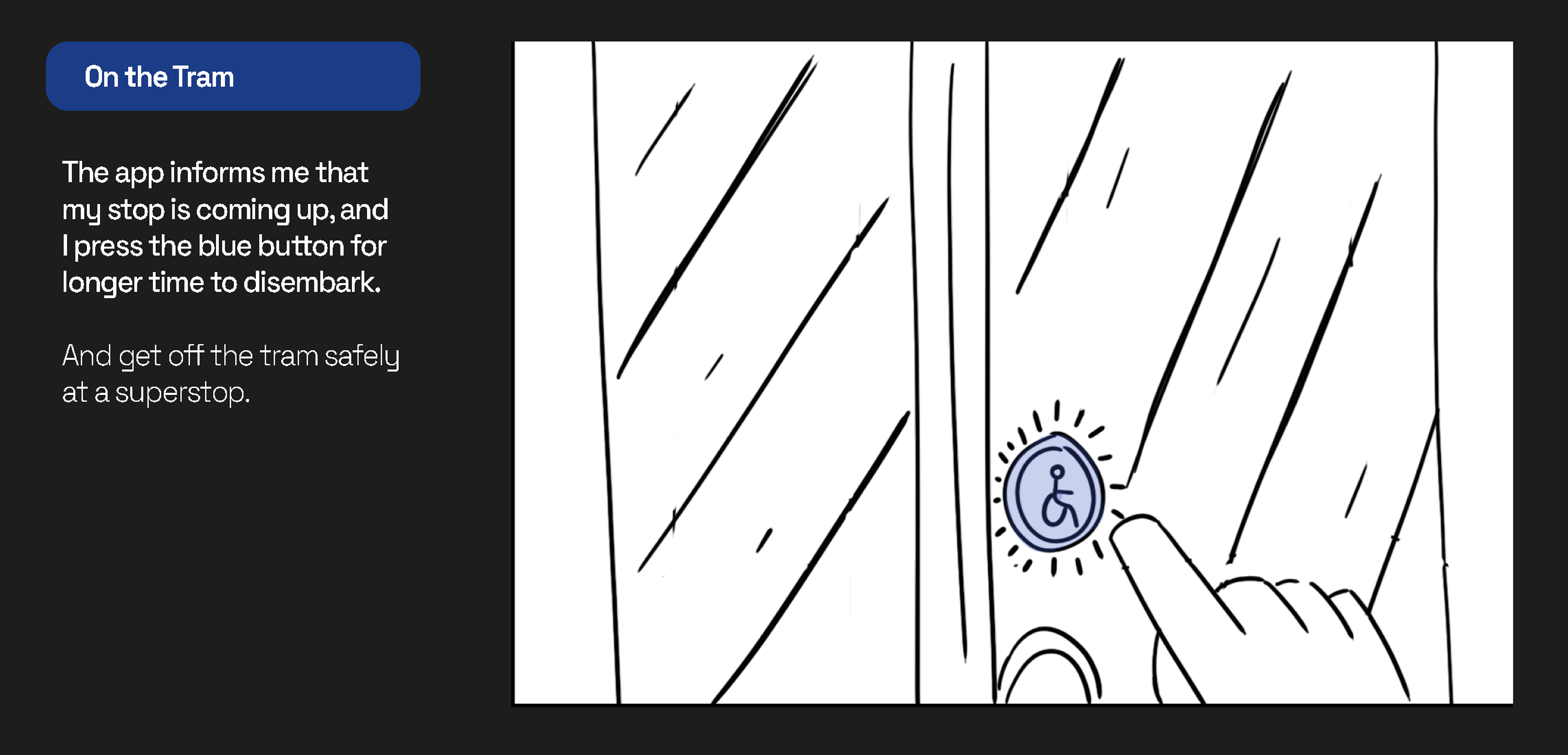
The app informs users to press the disembarking button, since it is crucial that they get off at the accessible stop - otherwise they might have to wait many more stops to disembark.

OUTCOME
App prototype - hover for more info / press for big picture
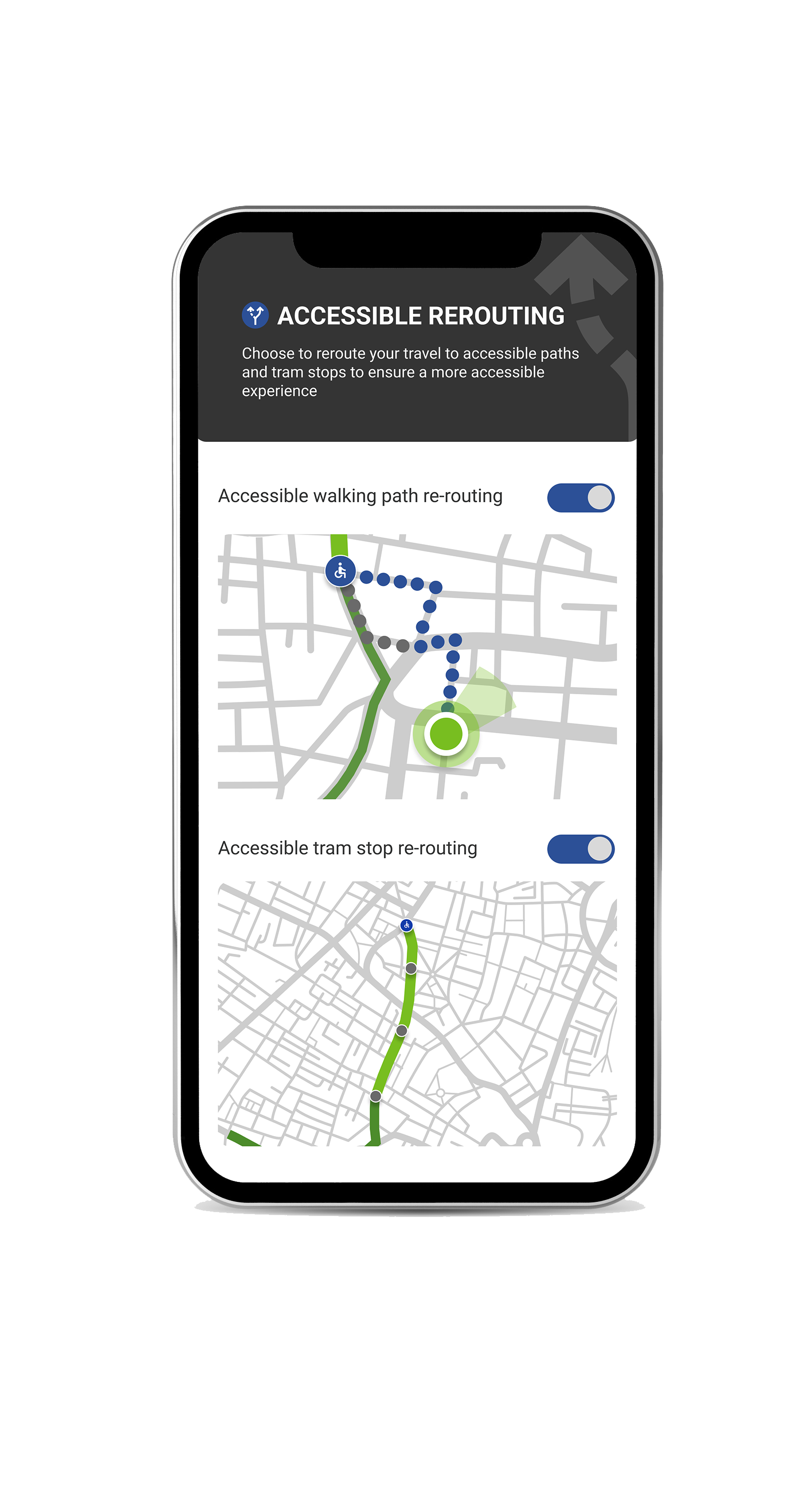
Accessible rerouting
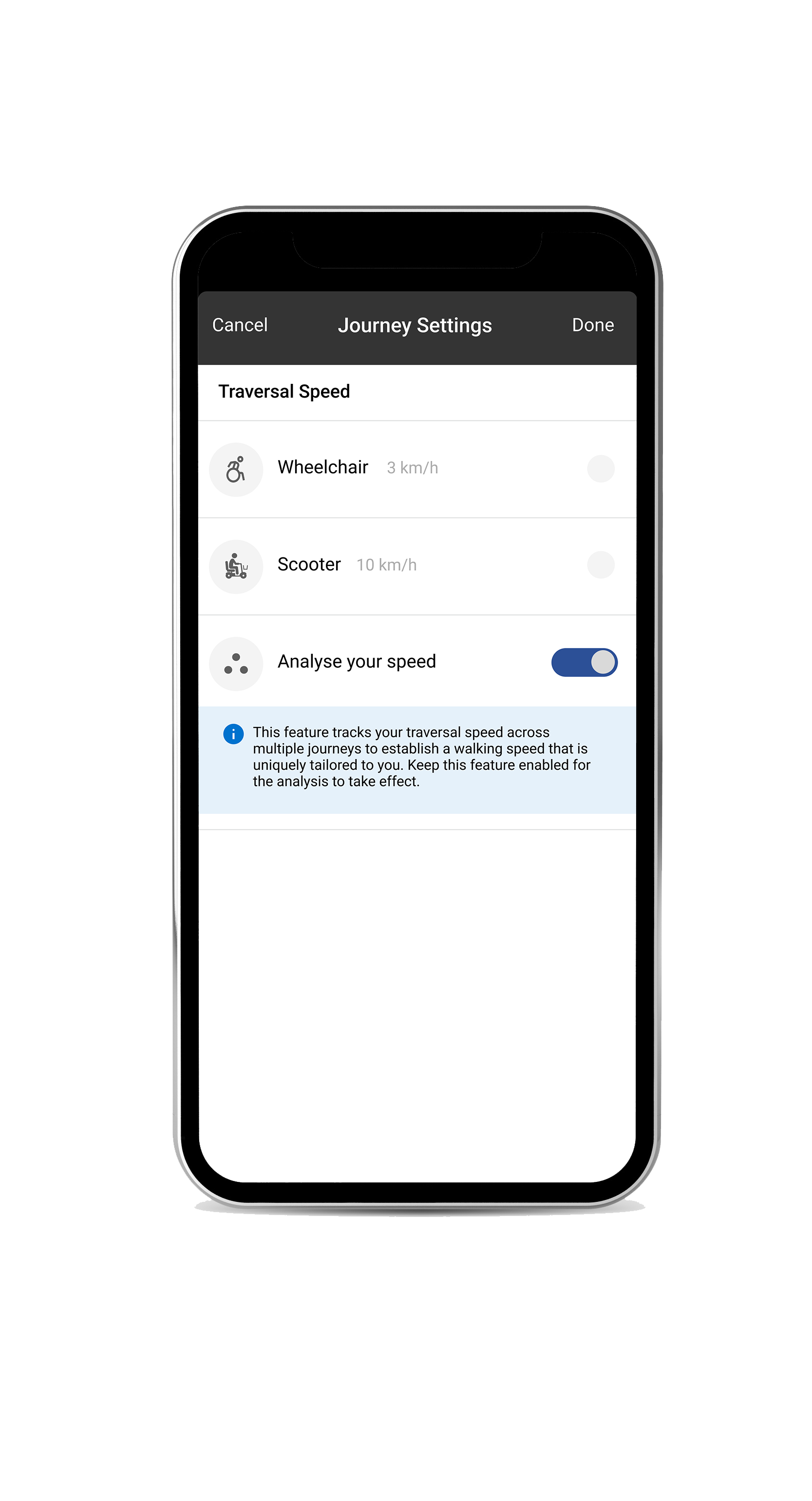
Smart wheeling speeds
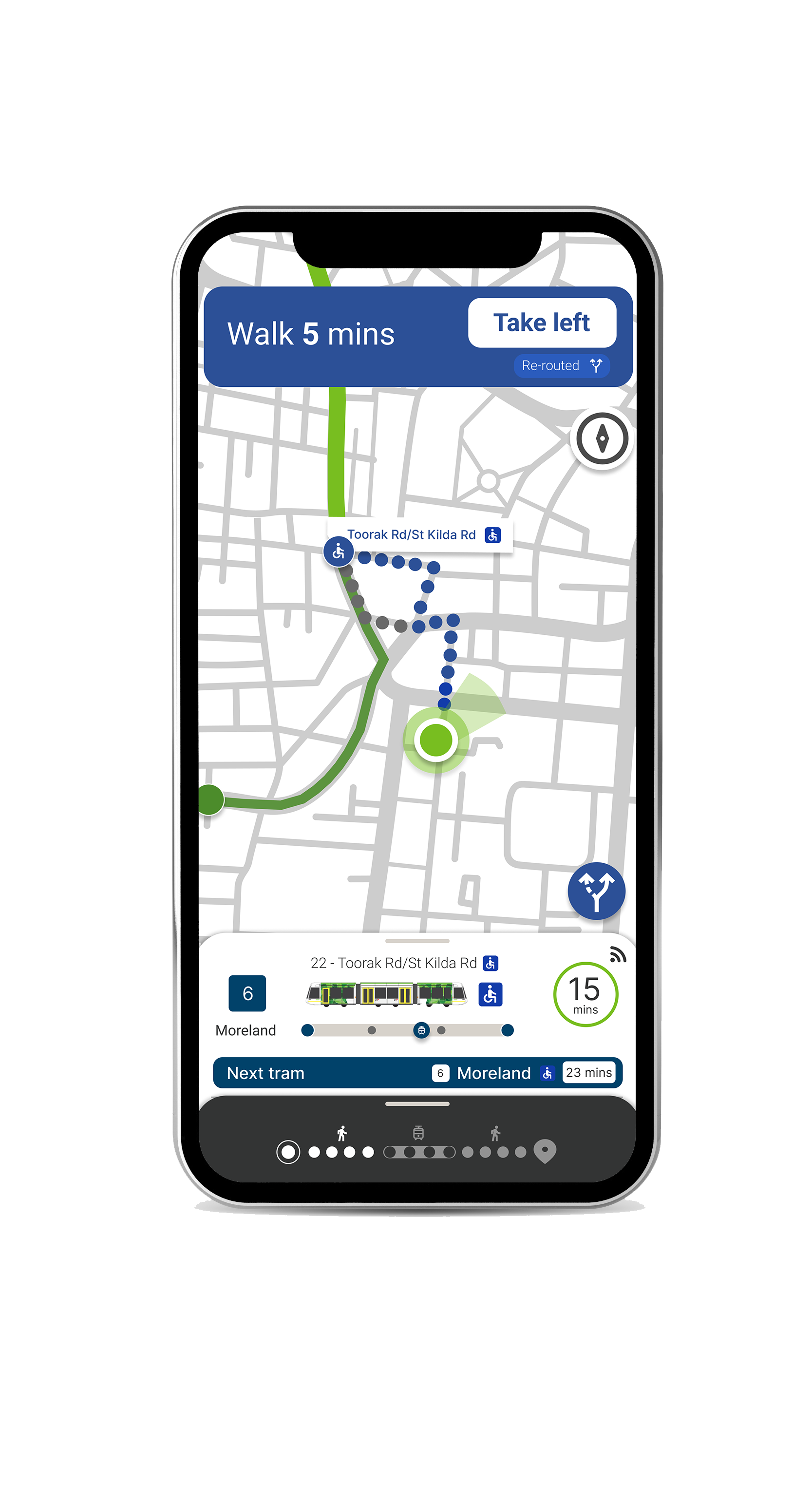
Accessible wheeling path
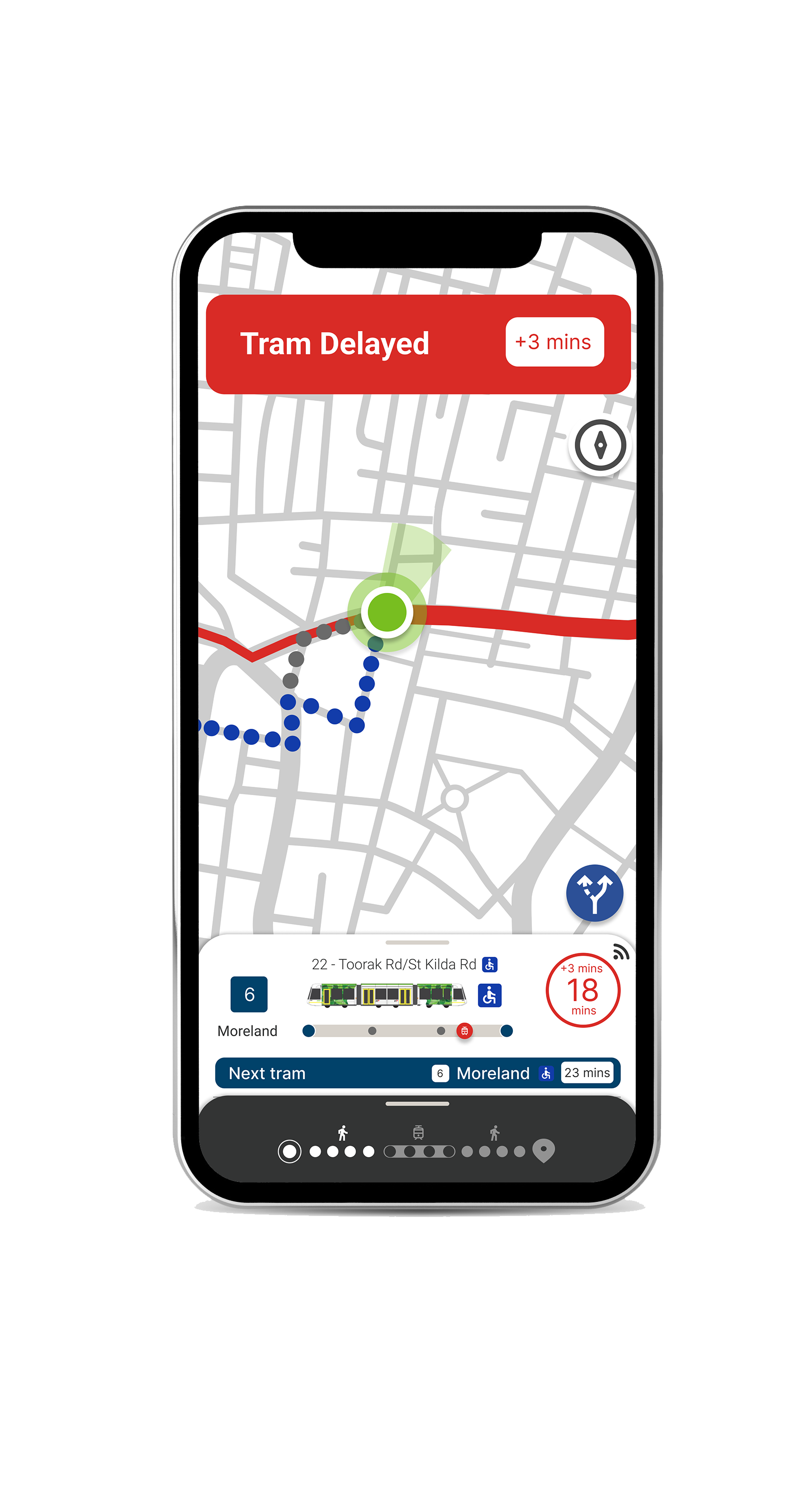
Urgent notifications
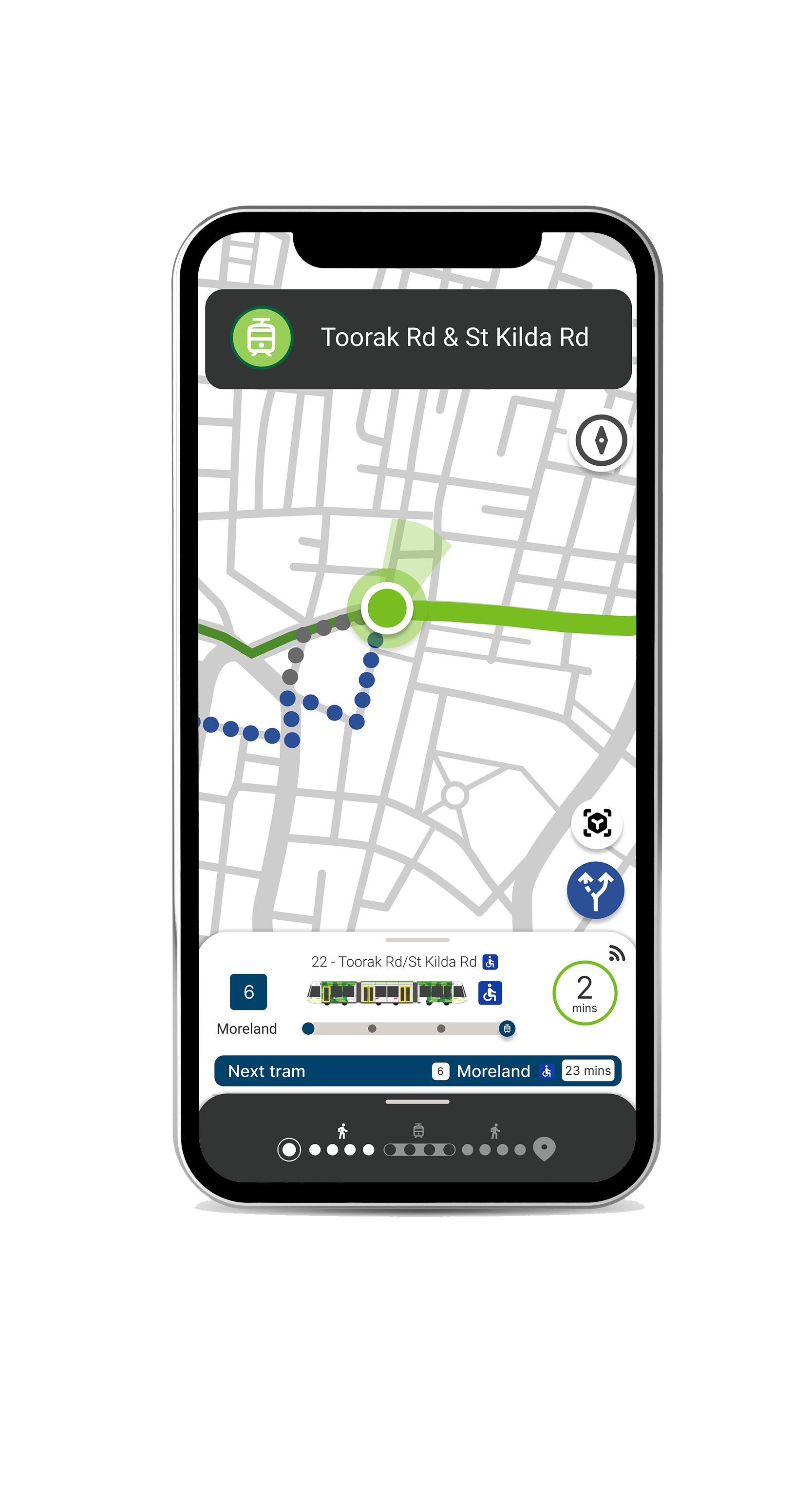
Waiting on tram

3D Map
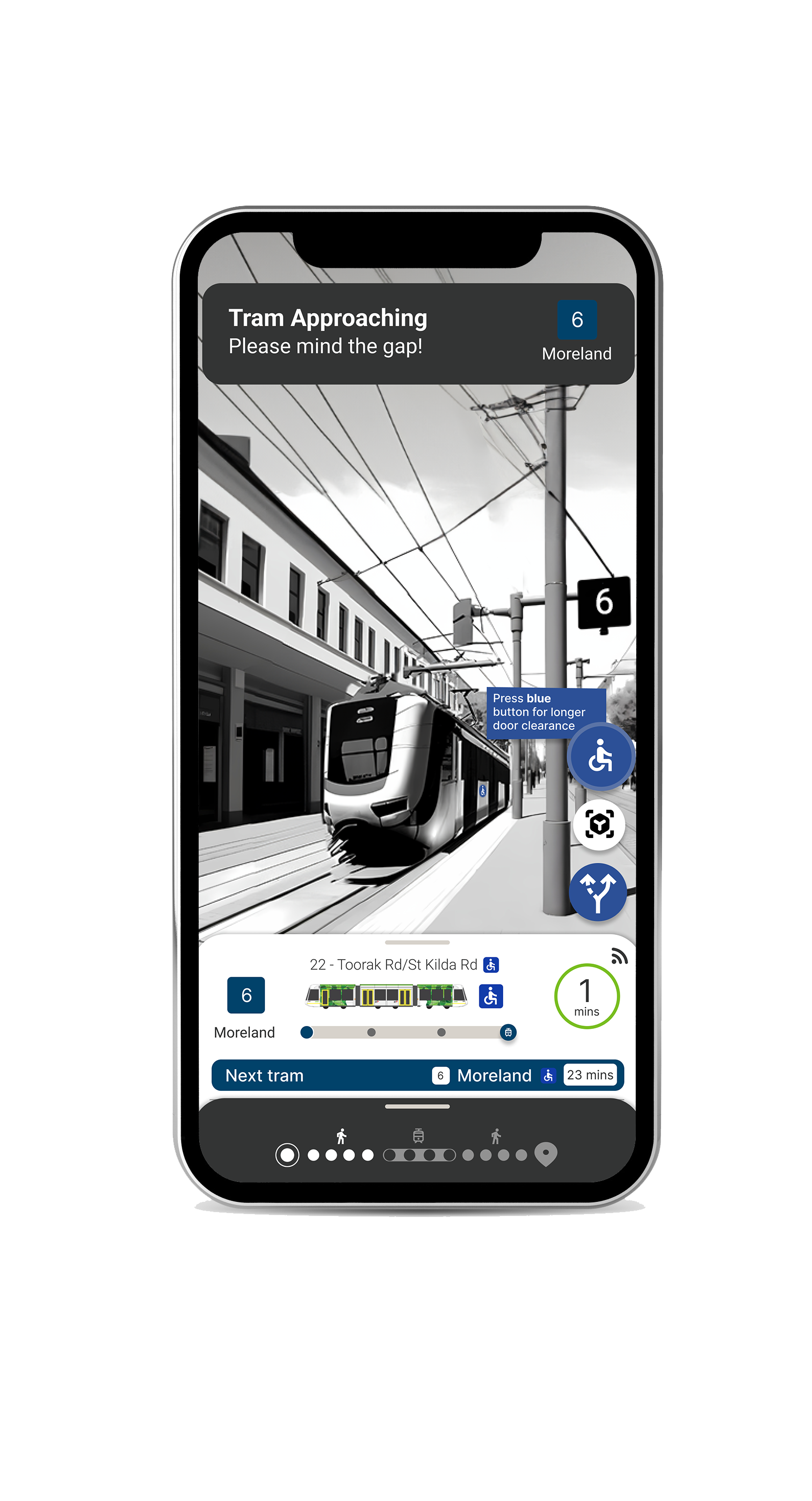
Digital blue button
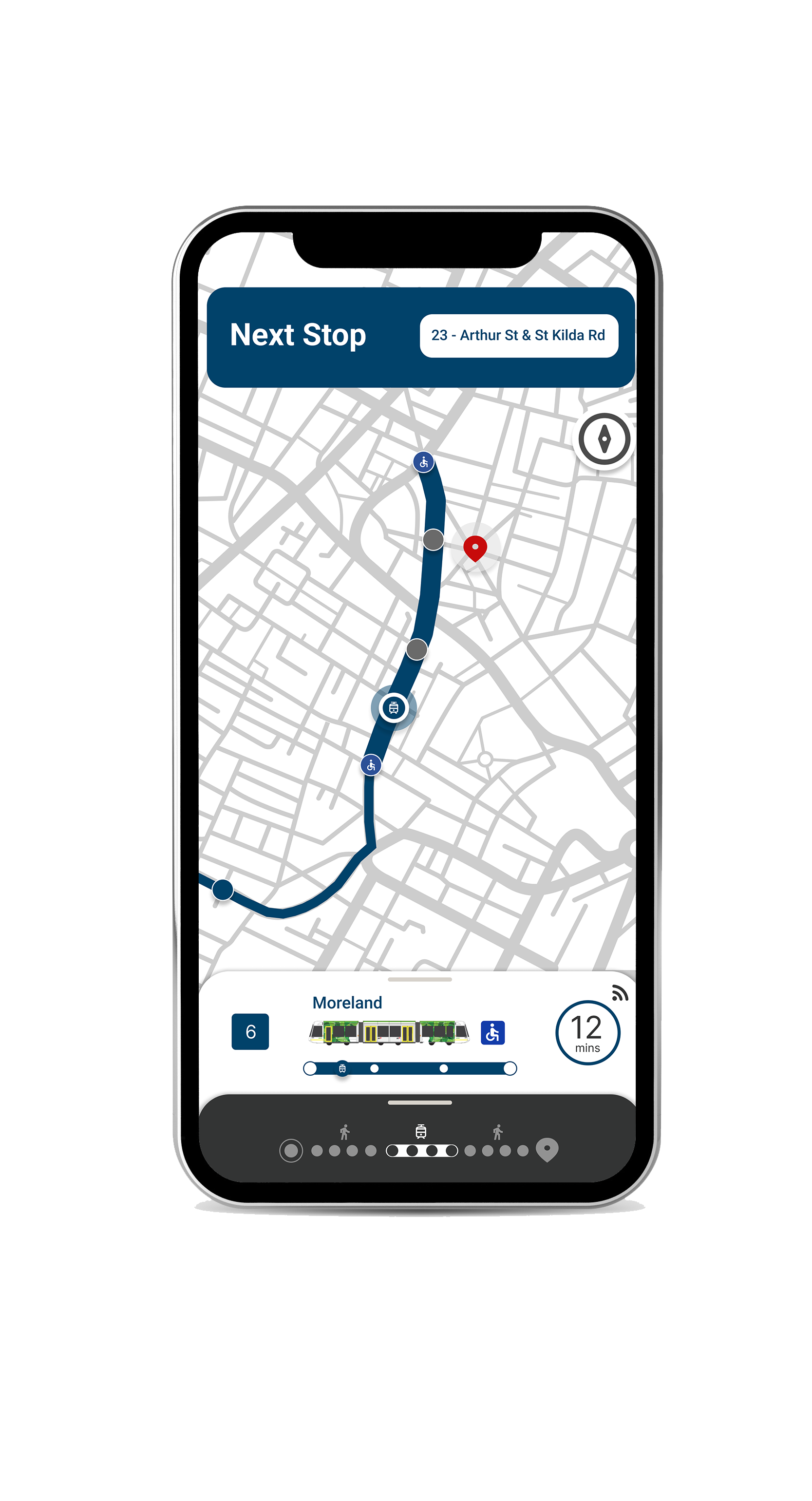
Accessible tram stops

Destination finder
Overview stats
REFLECTION
This project revolved around looking at a service where the infrastructure is so far off from being accessible, so the real job was to build a tool to work around the shortcomings - instead of imagining a perfect world. This taught me to find joy in the small wins, and to realise that a little help - is better than none. The problem here was mainly that users did not trust the app and avoided trams altogether, but with PTV Assist, you will never have to guess if a route is wheelchair accessible - you will know.